Music, Satire and Power in Egypt: The Political Songs of Sheikh Imam
Music, Satire and Power in Egypt
The Political Songs of Sheikh Imam
In the landscape of global protest music, few figures embody the intersection of popular culture and political dissent as powerfully as Sheikh Imam. Active in Egypt during the 1960s and 1970s, his songs—often written in collaboration with the poet Ahmed Fouad Negm—transformed music into a vehicle of social critique, political satire, and resistance .
This article examines Sheikh Imam’s work as a form of cultural opposition, focusing on how his songs challenged both domestic authority and global geopolitical alignments during a period marked by decolonization, pan-Arabism, and the Cold War.
The Rise of Political Music in Nasser’s Egypt
The emergence of protest music in Egypt must be understood within the broader political context of the 1960s. Under Gamal Abdel Nasser, the country promoted a strong discourse of Arab nationalism and resistance to Western influence.
While official culture emphasized unity and anti-imperialism, dissenting voices emerged within popular and student circles. It is within this environment that Sheikh Imam’s music developed, addressing themes such as poverty, inequality, and political repression .
Satire as Political Weapon: “Nixon Baba”
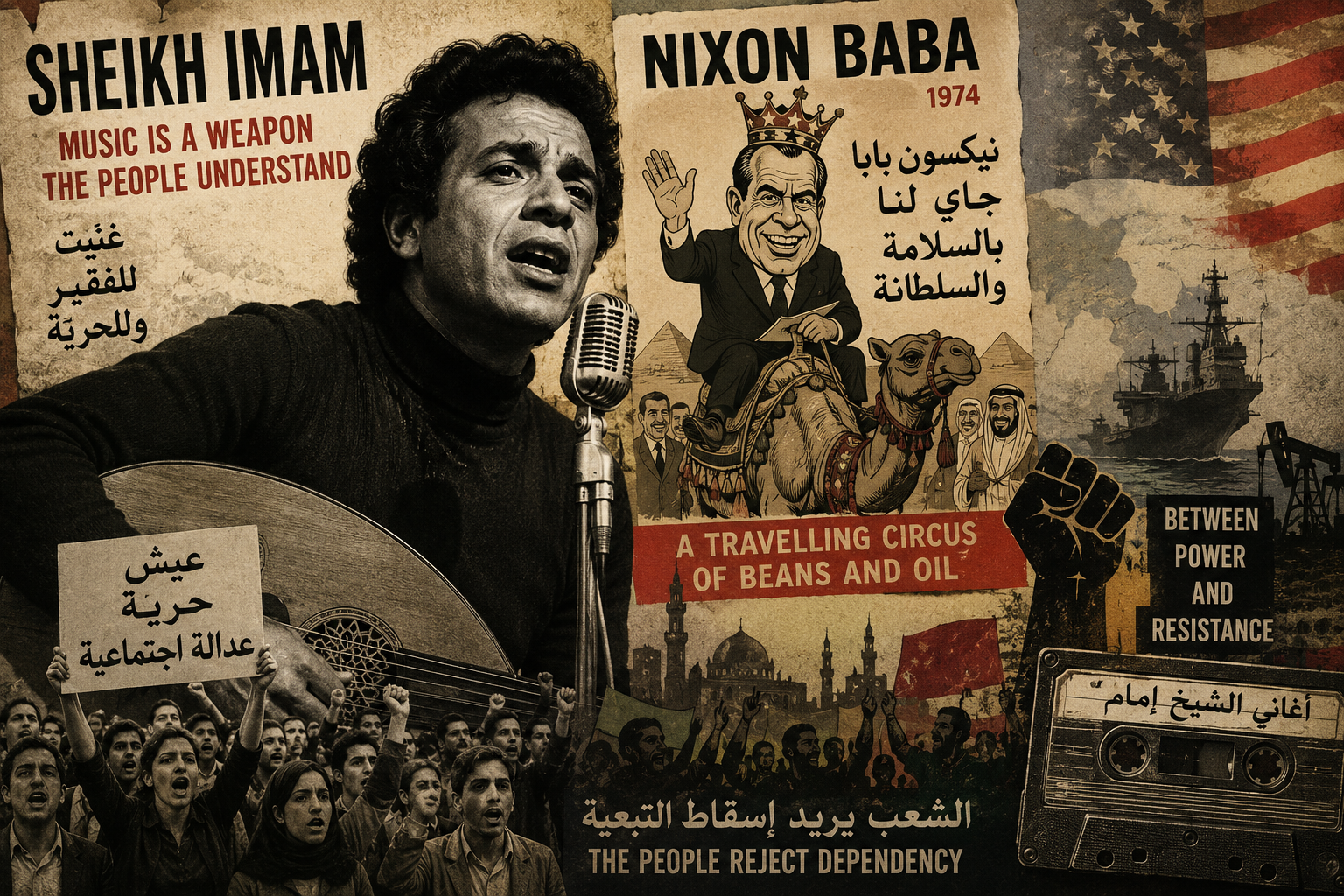
One of Sheikh Imam’s most striking songs is Nixon Baba (1974), written by Ahmed Fouad Negm. The song is a direct and ironic response to the visit of U.S. President Richard Nixon to Cairo, during the presidency of Anwar Sadat.
Far from being a gesture of diplomatic respect, the lyrics employ sharp satire to expose the contradictions of Egyptian foreign policy. Nixon is portrayed not as a respected leader, but as a figure welcomed by corrupt elites—“sultans of beans and oil”—in a theatrical and grotesque spectacle .
The imagery of the “travelling circus” and exaggerated ceremonial rituals reflects a deeper critique: political alliances are staged performances, not genuine expressions of sovereignty
Music and Anti-Imperial Critique
The song’s criticism extends beyond Egyptian domestic politics. It targets the broader framework of U.S. influence in the Middle East, particularly in the context of the Cold War.
By mocking Nixon and the Egyptian leadership simultaneously, Sheikh Imam’s music destabilizes both:
- local authority
- global power structures
This dual critique is significant. It positions Egyptian protest music not merely as national dissent, but as part of a wider anti-imperialist discourse.
Censorship and Repression
The political nature of Sheikh Imam’s work came at a cost. Both Imam and Negm were subject to censorship, including bans from radio and television, and periods of imprisonment .
Yet, their music continued to circulate through informal networks—cassette recordings, live performances, and word of mouth—particularly among students and working-class audiences.
This mode of circulation highlights an important dynamic: cultural resistance does not depend on institutional visibility
Popular Culture and Political Consciousness
Unlike elite forms of political discourse, Sheikh Imam’s songs were deeply rooted in popular culture. His use of colloquial Arabic and accessible musical forms allowed his message to reach a wide audience.
In this sense, his work represents a form of subaltern political expression, where music becomes a space for articulating grievances that are otherwise excluded from official narratives.
Egypt, the Global South, and Cultural Resistance
Sheikh Imam’s music can also be understood within the broader framework of the Global South. Like other forms of protest music across Africa, Asia, and Latin America, it reflects the tensions between:
- postcolonial sovereignty
- global dependency
- cultural autonomy
His songs reveal how global inequalities are experienced and contested at the local level, making music a key site of political negotiation.
Conclusion
Sheikh Imam’s legacy demonstrates that music can function as a powerful form of political intervention. Through satire, symbolism, and popular expression, his songs challenged both national authority and global hierarchies.
In doing so, they remind us that the politics of music are never confined to sound alone—they are embedded in the broader structures of power that shape the modern world.
Federico Paolini
This article is part of the research project: Music, Power and Global Inequality.


Commenti recenti