Hiroshima Peace Memorial (Japan, 2025): Ruins, Memory, and the Visual Layering of History
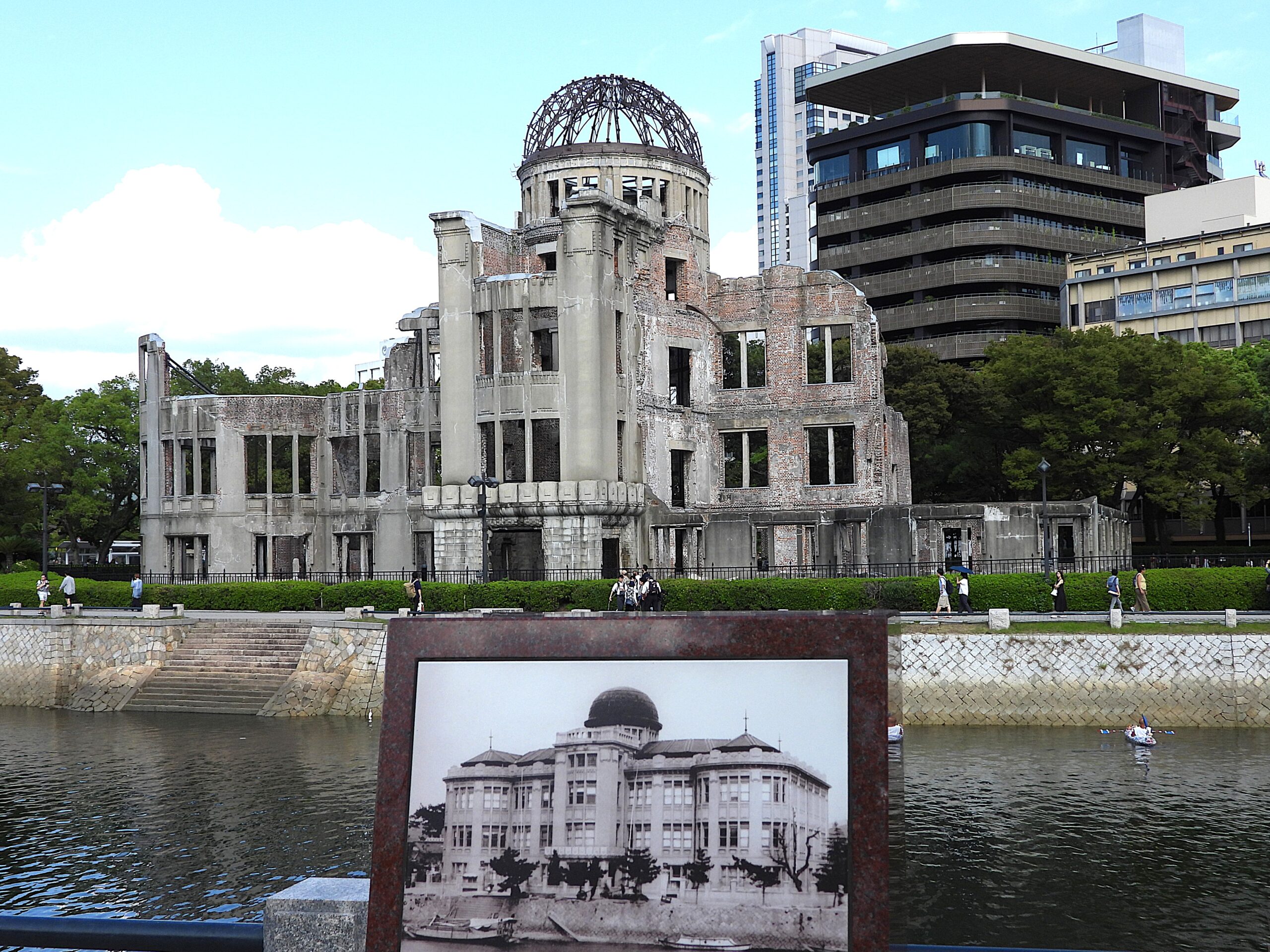
This photograph, taken in Hiroshima, Japan, in 2025, captures the Hiroshima Peace Memorial (Genbaku Dome), one of the most significant sites of memory associated with the atomic bombing of 1945. The image offers a powerful visual analysis of how historical trauma, memory, and urban space intersect in contemporary Japan.
At the center of the composition stands the preserved ruin of the building, its exposed structure and damaged surfaces bearing visible traces of destruction. The skeletal dome, partially collapsed yet still recognizable, functions as a stark reminder of the violence that transformed the city. Unlike reconstructed monuments, the ruin retains its material authenticity, allowing the past to remain physically present.
A key element of the image is the inclusion of a historical photograph in the foreground. This visual device creates a layered temporal perspective, juxtaposing the building in its original form with its current state as a ruin. The contrast between the intact structure in the archival image and the damaged remains behind it emphasizes the rupture caused by the atomic bombing, while also linking past and present within a single frame.
The surrounding environment further reinforces this temporal tension. Modern buildings rise behind the memorial, representing reconstruction, continuity, and the forward movement of urban life. At the same time, the preserved ruin interrupts this narrative of progress, anchoring the space in memory and loss.
Human figures appear scattered throughout the scene, moving along the riverbank and pathways. Their presence introduces a dimension of everyday life, suggesting how spaces of trauma are integrated into contemporary urban experience. Visitors do not merely observe the site; they inhabit it, contributing to its ongoing meaning.
From a visual history perspective, the Hiroshima Peace Memorial exemplifies how ruins function as active agents of memory. Rather than closing the past, they keep it open, inviting reflection and interpretation. The image highlights how visual strategies—such as juxtaposition, framing, and scale—can make historical processes legible within the present.
Ultimately, this Hiroshima photograph (2025) can be read as a meditation on the persistence of memory in urban space. It reveals how destruction, preservation, and reconstruction coexist, shaping how history is seen, remembered, and understood.


Commenti recenti