Why Populist Movements Are Growing. Inequality, Political Realignment, and the Sound of Economic Anger from Vasco Rossi to Oliver Anthony
The rapid growth of populist movements across Europe is often explained through the personalities of political leaders, media strategies, or the emotional dynamics of contemporary politics. Yet focusing too heavily on political actors risks obscuring the deeper structural transformations that have reshaped Western societies over the last four decades.
The recent local elections in the United Kingdom offer a striking example. The strong performance of Reform UK, combined with the severe decline of the Labour Party in several areas, reflects more than temporary electoral volatility. It signals a broader crisis of political representation linked to long-term economic and social change.
Across much of the Western world, large sections of the electorate increasingly perceive traditional parties — especially centre-left parties — as unable or unwilling to represent the material insecurities generated by globalization, deindustrialization, financialization, and rising inequality. In this context, populist movements do not emerge from nowhere. They develop inside societies marked by growing frustration, declining social mobility, and weakening trust in established institutions.
Globalization and the Fragmentation of Social Stability
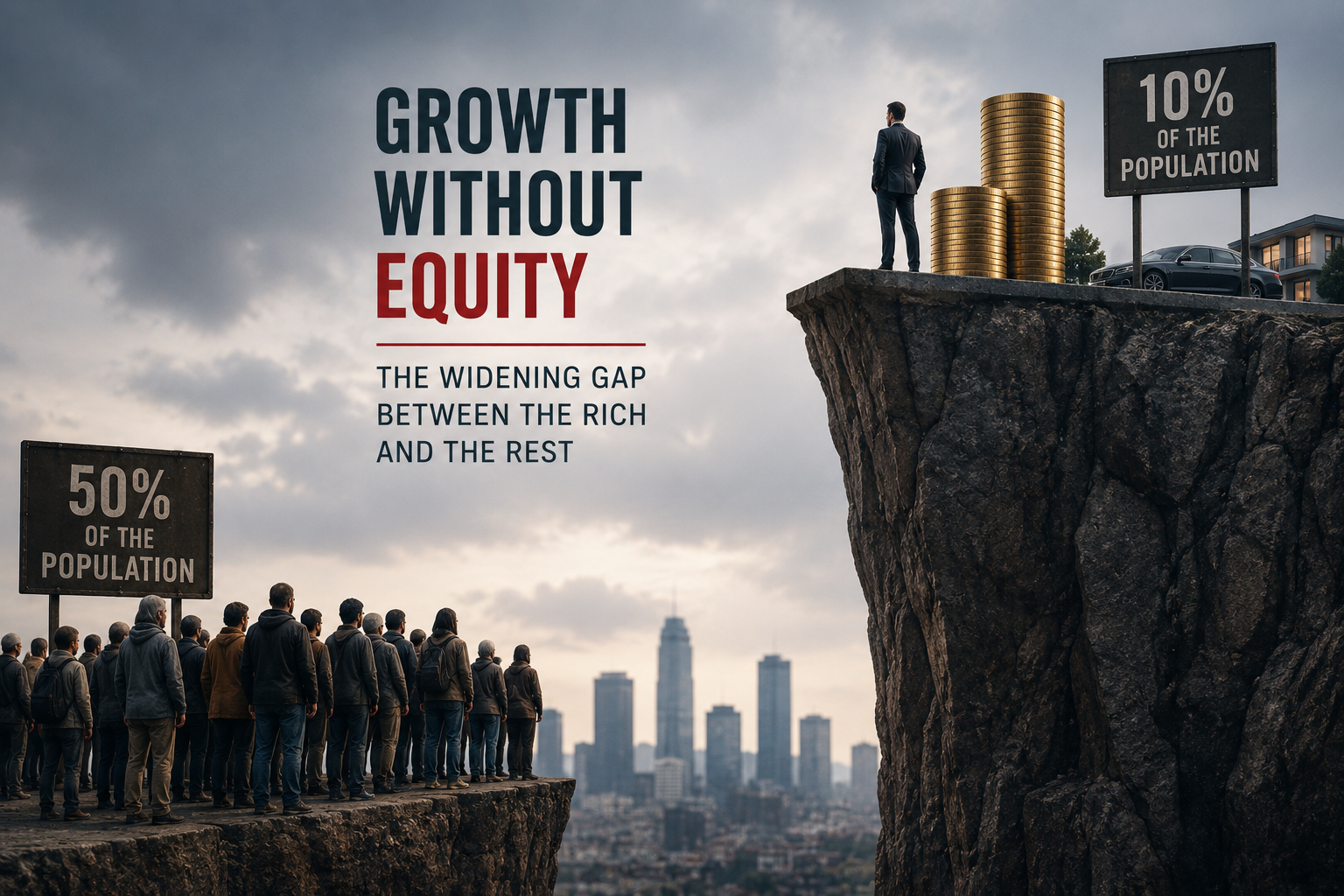
Since the 1980s, advanced capitalist economies have undergone profound restructuring. Globalization expanded international trade, increased productivity, accelerated technological innovation, and generated enormous concentrations of wealth. At the same time, however, the distribution of these gains became increasingly uneven.
While economic growth continued, wages for large parts of the working and lower-middle classes stagnated. Manufacturing regions experienced deindustrialization, unions weakened, and precarious employment expanded. In many countries, wealth became increasingly concentrated among those who owned financial assets, property, and capital rather than those dependent on wages.
This transformation produced a paradoxical condition: societies became richer overall while many citizens felt economically and socially more insecure than previous generations.
The consequences were not merely economic. They were deeply political.
As inequality widened and social mobility slowed, growing numbers of voters began to lose confidence in institutions, experts, and traditional political parties. The perception that economic systems primarily benefited metropolitan elites, financial sectors, and highly educated professionals created fertile ground for anti-establishment politics.
The Crisis of the Centre-Left
One of the most important political developments of the last thirty years has been the gradual repositioning of many centre-left parties toward the political and economic centre.
Parties historically connected to labour movements and industrial working classes increasingly embraced market liberalization, fiscal moderation, financial globalization, and technocratic governance. This shift was often presented as pragmatic modernization capable of reconciling social justice with global competitiveness.
Yet this transformation also weakened the traditional social identity of the left.
In many post-industrial regions, voters who once viewed social democratic parties as defenders of workers’ interests began to perceive them as culturally distant and economically detached. The language of redistribution was progressively replaced by the language of management, modernization, and macroeconomic stability.
As a result, many citizens facing stagnant wages, insecure employment, declining public services, and rising living costs no longer felt politically represented.
This vacuum became one of the key conditions behind the growth of contemporary populism.
Why Populist Parties Gain Support
Populist movements succeed not simply because they offer radical solutions, but because they provide emotionally and politically coherent explanations for social decline.
Their central narrative is remarkably consistent across countries:
- the system is rigged;
- political elites have abandoned ordinary people;
- globalization benefits only a privileged minority;
- national sovereignty has been weakened;
- traditional parties no longer represent the population.
These arguments resonate particularly strongly in regions affected by industrial decline and long-term economic stagnation.
The success of Brexit illustrated this dynamic clearly. Although formally centred on European Union membership, the referendum became for many voters a broader protest against an economic order perceived as unequal and exclusionary. In numerous post-industrial communities, opposition to the EU overlapped with resentment toward London-based financial elites, austerity policies, and decades of regional neglect.
The same mechanisms can be observed in the rise of Donald Trump in the United States, where growing income concentration, stagnant wages, and declining social security contributed to the emergence of a highly polarized political landscape.
In both cases, populism transformed diffuse economic frustration into a political conflict framed as “the people versus the elites.”
Inequality and Political Polarization
The relationship between inequality and political instability is increasingly difficult to ignore.
When economic growth disproportionately benefits upper-income groups while large parts of society experience stagnation or decline, democratic systems tend to become more polarized. Citizens who perceive themselves as excluded from prosperity become more willing to support anti-establishment actors promising disruption, protection, or radical change.
Importantly, this process does not necessarily emerge from absolute poverty. In many cases, it is driven by relative decline and perceived loss of status.
People react politically not only when they become poor, but when they feel they are working harder without improving their lives, while wealth accumulates elsewhere.
This perception has become central to contemporary populist discourse.
Reform UK and the British Political Shift
The recent British elections reveal how far this transformation has advanced. The growth of Reform UK cannot be reduced to a temporary protest vote or charismatic leadership alone. It reflects a wider fragmentation of the traditional political order.
The weakening of both Labour and the Conservatives demonstrates that many voters no longer identify with the historical structures that dominated British politics throughout the twentieth century.
For Labour in particular, the challenge is profound. The party increasingly struggles to maintain support among working-class and economically insecure voters who once formed its historical electoral base. The move toward centrist politics may have expanded credibility among moderate and professional voters, but it also left significant sections of the population politically orphaned.
Populist movements have moved rapidly to occupy that space.
Populism as a Structural Phenomenon
Treating populism as an irrational anomaly risks misunderstanding the historical forces behind its growth.
The rise of populist politics is closely connected to the long-term consequences of neoliberal globalization, wealth concentration, labour fragmentation, and declining confidence in representative institutions. These developments created societies that are economically dynamic but socially fragile.
In this sense, contemporary populism is less a sudden rupture than a predictable response to decades of uneven growth and political realignment.
As long as large parts of the population continue to perceive that economic systems reward elites while offering insecurity to everyone else, anti-establishment politics will likely remain a central feature of Western democracies.
Cultural Anger and the Soundtrack of Economic Frustration
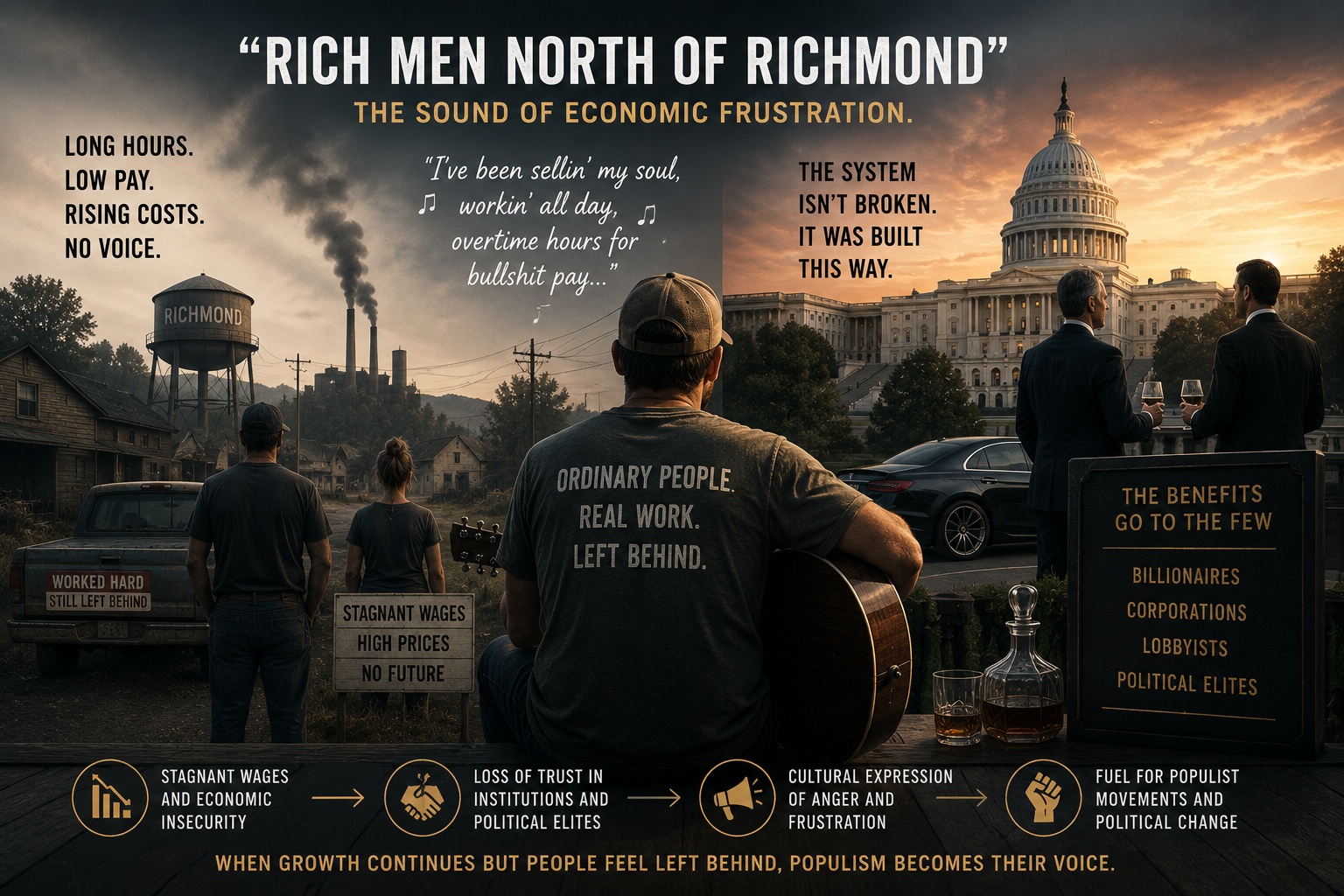
The growth of populism is not expressed only through elections, party systems, or political rhetoric. It also emerges through popular culture, music, and collective emotional narratives. One of the clearest recent examples is the viral success of “Rich Men North of Richmond” by Oliver Anthony.
The song became enormously popular in the United States because it articulated a diffuse sense of economic exhaustion and social abandonment felt by many working- and lower-middle-class citizens. Its lyrics describe long working hours, stagnant wages, rising living costs, distrust toward political elites, and the perception that ordinary people are increasingly powerless inside a system designed for the benefit of others.
What made the song politically significant was not simply its ideological content, but its ability to translate structural economic frustrations into an emotionally accessible language. The “rich men north of Richmond” are presented as distant elites who control politics, taxation, and economic life while ordinary workers struggle to maintain stability and dignity.
This narrative closely mirrors the broader mechanisms behind contemporary populism:
- economic growth perceived as benefiting only elites;
- distrust toward institutions and political classes;
- resentment against centralized power;
- perception of social exclusion despite continued work and productivity.
Importantly, the song should not be interpreted merely as a conservative cultural phenomenon. Its success reveals something deeper: the erosion of the traditional relationship between labour, political representation, and social mobility.
For much of the twentieth century, social democratic and labour-oriented parties were able to channel economic frustrations into organized political representation. Today, however, many voters no longer believe that traditional centre-left parties genuinely defend their material interests. As these parties moved toward technocratic centrism and accepted many assumptions of neoliberal globalization, large parts of their historical social base became politically detached.
In this vacuum, populist movements increasingly dominate the language of economic anger.
The significance of “Rich Men North of Richmond” lies precisely here. The song demonstrates how cultural products can become vehicles for political emotions generated by long-term inequality, stagnating wages, and declining trust in institutions. What appears on the surface as cultural resentment is often rooted in structural economic transformations that have reshaped Western societies over several decades.
In this sense, contemporary populism is not only a political phenomenon. It is also a cultural response to a world in which many people feel that economic growth continues, but social inclusion does not.
An Earlier Warning: Vasco Rossi and the Roots of Anti-Elite Anger in 1990s Italy
Long before “Rich Men North of Richmond” became a symbol of contemporary economic frustration in the United States, similar themes had already emerged in European popular culture. One particularly revealing example is “Gli spari sopra” by Vasco Rossi, released in 1993 during one of the most dramatic political crises in modern Italian history.
The song appeared at a crucial historical moment. Italy was being shaken by the Mani Pulite investigations, the massive anti-corruption judicial inquiry that exposed the systemic relationship between political parties, business networks, and illegal financing. The crisis destroyed much of the postwar political order, leading to the collapse of the traditional party system that had governed the country for decades.
In this context, “Gli spari sopra” captured a diffuse atmosphere of distrust, anger, and social disillusionment. Its lyrics revolve around themes that would later reappear in many forms of contemporary populist discourse:
- political hypocrisy;
- elite impunity;
- social inequality;
- manipulation by those in power;
- abandonment of ordinary people;
- moral corruption of institutions.
Lines such as “Se non state mai coi deboli” (“If you are never on the side of the weak”) or “Prendere, manipolare e fare credere” (“Take, manipulate, and make people believe”) directly attack the perceived cynicism of political and economic elites. The repeated refrain — “gli spari sopra sono per noi” (“the shots above are for us”) — evokes the feeling that ordinary citizens bear the consequences of decisions made elsewhere by insulated centres of power.
What makes the comparison with Rich Men North of Richmond particularly interesting is that both songs emerge from periods of deep institutional crisis and social transformation.
In the Italian case, the early 1990s represented the collapse of the so-called First Republic, marked by corruption scandals, economic uncertainty, and declining trust in political institutions. In the American case, the success of Oliver Anthony’s song reflects the long-term consequences of deindustrialization, wage stagnation, rising inequality, and growing hostility toward political elites in Washington.
Despite their different cultural and historical contexts, both songs articulate a remarkably similar emotional structure:
- ordinary people feel abandoned;
- institutions appear distant and self-serving;
- political systems are perceived as benefiting elites;
- social frustration is transformed into cultural anger.
This parallel also highlights a broader historical point: populist sentiments do not suddenly emerge in the digital age or through social media alone. They have deeper roots connected to recurring crises of representation inside capitalist democracies.
Popular music often becomes one of the first spaces where these tensions are emotionally articulated before they fully explode in electoral politics.
In retrospect, “Gli spari sopra” can be read not simply as a protest song of early 1990s Italy, but as an early cultural expression of the anti-elite resentment that would later become central to much of twenty-first-century populist politics across the Western world.
Federico Paolini
This article is part of the research project: Music, Power and Global Inequality.


Commenti recenti