Billy the Kid and the American Imagination: From Aaron Copland to Bob Dylan
Few figures in American cultural history have traveled across as many symbolic landscapes as Billy the Kid. Outlaw, murderer, folk hero, rebel, anti-hero: his image has constantly shifted according to the anxieties and aspirations of different historical periods. More than a simple gunfighter of the nineteenth-century frontier, Billy the Kid became a cultural mirror through which Americans projected their changing relationship with power, modernity, capitalism, and individual freedom.
What makes the figure especially significant is not the historical reality of Henry McCarty—better known as Billy the Kid—but the extraordinary ability of musicians, composers, and songwriters to transform him into a symbolic language of resistance. From the orchestral nationalism of Aaron Copland to the populist mythology of country music and the melancholic revisionism of Bob Dylan, Billy the Kid evolved into one of the most enduring anti-heroes in American popular culture.
Billy the Kid and the Crisis of Power in the American West
The historical Billy the Kid emerged from the violent transformations of the post-Civil War American Southwest. The expansion of capitalist ranching, railroad interests, commercial monopolies, and Anglo-American political control profoundly reshaped territories such as New Mexico during the late nineteenth century. Within this context, the Lincoln County War represented more than a local feud: it exposed the instability of a frontier society increasingly dominated by concentrated economic power.
Billy’s later mythification depended precisely on this setting. He could be imagined not merely as a criminal but as a symbolic opponent of emerging systems of authority. Like many legendary outlaws, he occupied an ambiguous space between social violence and popular resistance.
This ambiguity helps explain why Billy the Kid repeatedly resurfaced during moments of political and cultural tension in American history. His image became especially powerful whenever large institutions appeared to threaten local autonomy, individual independence, or democratic ideals.
Aaron Copland and the Nationalization of the Outlaw Myth
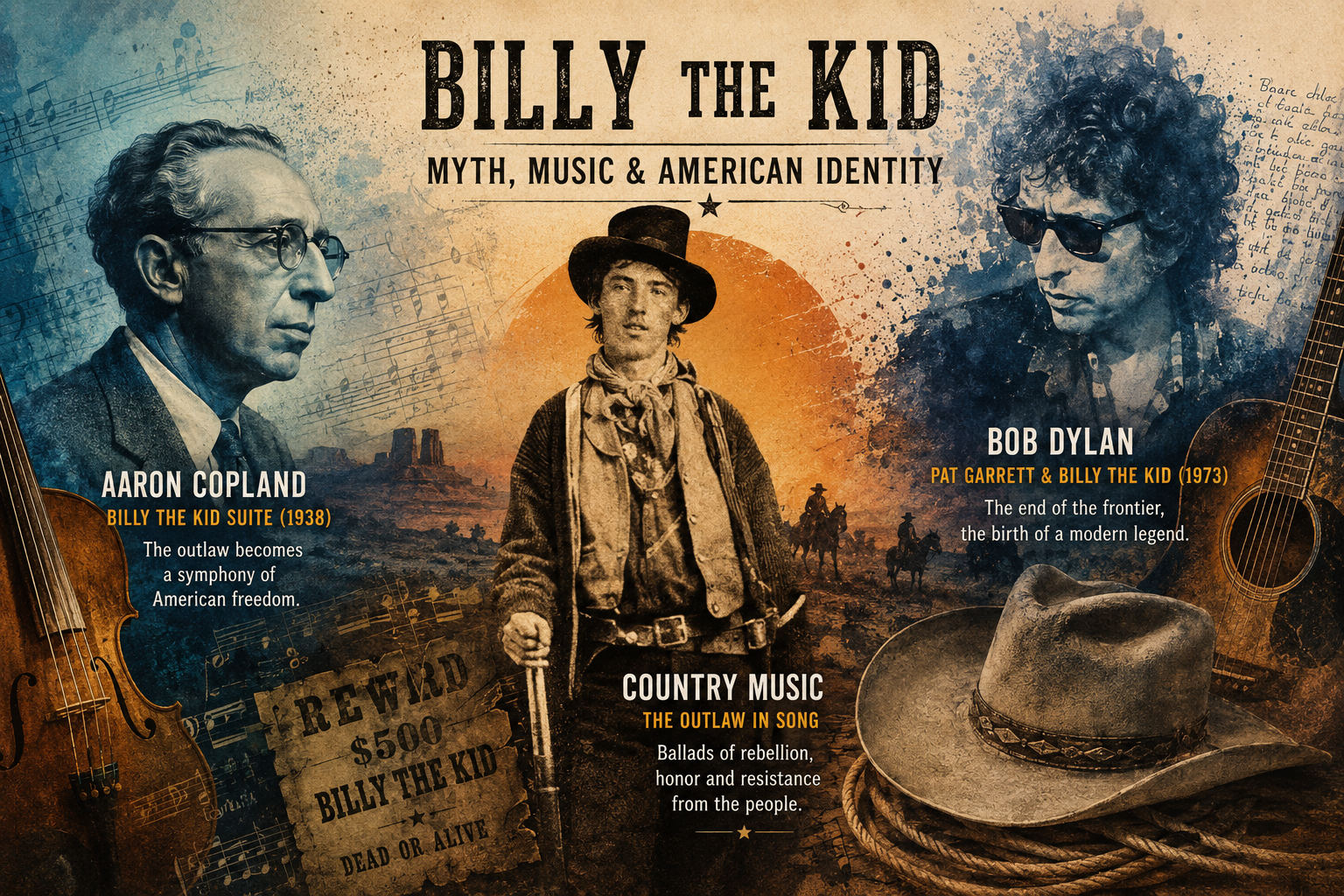
The decisive transformation of Billy the Kid into a national cultural symbol occurred with Billy the Kid (1938), composed by Aaron Copland during the New Deal era.
Copland’s work was not simply a musical representation of the American West. It formed part of a broader cultural project that sought to construct a distinctly American artistic identity. During the 1930s, composers, writers, photographers, and filmmakers increasingly turned toward rural landscapes, folk traditions, and frontier mythology in order to define a democratic national culture separate from European models.
In this context, Billy the Kid became a paradoxical national hero. Copland transformed a marginal outlaw into a monumental symbol of the frontier experience. The ballet’s use of folk melodies, open harmonies, and expansive orchestration produced what many listeners perceived as the sound of “America” itself. Yet beneath this celebratory atmosphere remained a deeper tension: the nation’s democratic mythology was being built upon figures associated with violence, illegality, and resistance to institutional authority. This was one of the central contradictions of American modernity. The United States repeatedly incorporated anti-systemic figures into its national mythology. The outlaw was not excluded from the national narrative; he was absorbed into it.
In Copland’s hands, Billy ceased to be merely a fugitive. He became:
- the embodiment of frontier individualism,
- the symbol of territorial freedom,
- the memory of a pre-industrial America,
- and ultimately a cultural foundation myth.
The transformation was highly significant because it neutralized some of the political implications of the historical figure. Billy’s conflicts with economic monopolies and systems of regional domination were partially replaced by a broader, more universal mythology of freedom and self-determination.
Country Music and the Populist Outlaw Tradition
If Aaron Copland transformed Billy the Kid into a symbol of national culture, country music brought him back into the vernacular world of popular memory and social rebellion.
Throughout the twentieth century, western ballads and country songs repeatedly used Billy the Kid as a symbolic figure through which musicians explored tensions surrounding law, class, and institutional authority. In these songs, historical precision mattered far less than emotional and cultural resonance. Billy represented the outsider who resisted systems perceived as distant, corrupt, or socially oppressive.
One of the earliest and most influential examples was Marty Robbins’s Billy the Kid, included in the broader tradition of narrative western ballads that shaped the mythology of the frontier in postwar America. Robbins portrayed Billy not simply as a criminal, but as part of a disappearing world governed by personal honor, territorial freedom, and resistance to centralized authority.
This symbolic framework expanded further through the outlaw country movement of the 1970s. Songs such as Joe Ely’s Me and Billy the Kid reinterpreted the outlaw myth through a more explicitly anti-establishment lens. Here Billy became associated with cultural marginality, artistic independence, and resistance against institutional conformity.
Similarly, Billy Joel’s The Ballad of Billy the Kid demonstrated how the figure had moved beyond traditional western music into the wider landscape of American popular culture. Although historically inaccurate in many respects, the song revealed something more important: Billy the Kid had become a metaphor for the construction of American myth itself.
By the 1970s, the outlaw no longer symbolized only frontier violence. He increasingly represented opposition to bureaucracy, corporate power, commercial standardization, and the growing sense that modern America had lost older forms of local autonomy and individual freedom.
For this reason, Billy the Kid occupied a central position within outlaw country culture. Artists connected to the movement frequently positioned themselves against:
- the industrial discipline of Nashville,
- the homogenization of popular music,
- and broader structures of institutional control.
The outlaw therefore became more than a western archetype: he evolved into a symbolic language of cultural resistance.
Bob Dylan and the End of the Frontier Myth
The most profound reinterpretation of Billy the Kid emerged in the 1970s through Bob Dylan’s work for Pat Garrett and Billy the Kid.
Unlike Copland, Dylan did not monumentalize the frontier. Instead, he presented its collapse.
The film and soundtrack portray a world in transition, where older forms of autonomy are being destroyed by modernization, capitalist expansion, and institutional consolidation. Billy is no longer the heroic embodiment of national energy. He becomes instead a tragic remnant of a disappearing social order.
The crucial figure in this reinterpretation is Pat Garrett himself. Garrett represents incorporation into the system: the former outsider who accepts institutional authority and participates in the destruction of frontier independence. Billy, by contrast, remains outside integration. He becomes the final symbol of resistance against a rapidly bureaucratizing America.
This reinterpretation reflected the broader political atmosphere of the 1970s:
- post-Vietnam disillusionment,
- distrust toward government,
- the crisis of American exceptionalism,
- and growing skepticism toward official narratives of progress.
Dylan’s Billy is therefore profoundly melancholic. The outlaw no longer appears capable of changing history. He survives only as memory, song, and cultural residue.
Billy the Kid as an American Anti-Hero
The endurance of Billy the Kid in American music reveals something fundamental about the cultural history of the United States. American society repeatedly generates anti-heroes who challenge systems of power while simultaneously becoming integrated into national mythology.
This dynamic explains why Billy the Kid could move so easily across:
- folk music,
- country ballads,
- orchestral composition,
- Hollywood westerns,
- and countercultural songwriting.
Each reinterpretation corresponded to different historical concerns:
- frontier expansion,
- industrial capitalism,
- national identity,
- Cold War individualism,
- or anti-establishment critique.
Yet a common thread remained constant: Billy symbolized resistance against asymmetrical forms of power.
Whether represented as a folk outlaw, a populist cowboy, or a tragic anti-hero, Billy the Kid persisted because he embodied one of the deepest tensions in American culture: the conflict between institutional authority and the mythology of individual freedom.
In that sense, the historical outlaw mattered less than the cultural need he continued to satisfy. Billy the Kid survived not because Americans remembered him accurately, but because each generation reinvented him according to its own fears about power, inequality, and the loss of autonomy.
Streaming Platforms and the Contemporary Return of Billy the Kid
The recent television series Billy the Kid, created by Michael Hirst and distributed through MGM+ and Prime Video, demonstrates how the outlaw continues to function as a powerful cultural figure in the twenty-first century.
Unlike many earlier western representations, the series strongly emphasizes Billy’s social marginality, immigrant background, and structural vulnerability. The young Henry McCarty is portrayed not simply as a gunslinger, but as a displaced and economically precarious subject moving through a violent frontier shaped by inequality, land conflicts, and emerging capitalist power structures.
This reinterpretation is historically significant because it aligns with broader contemporary tendencies in popular culture:
- skepticism toward institutions,
- criticism of concentrated power,
- renewed interest in marginalized identities,
- and distrust of official historical narratives.
In many ways, the series reconnects Billy the Kid to the anti-hegemonic dimensions that had partially disappeared in earlier heroic western mythology.
At the same time, the visual language of contemporary streaming television transforms the outlaw into a globally consumable cultural product. Billy becomes simultaneously:
- historical character,
- political metaphor,
- entertainment icon,
- and transnational streaming commodity.
This tension is central to understanding the survival of the myth today. Even contemporary capitalism continues to recycle figures originally associated with resistance against asymmetrical systems of power.
The result is a striking continuity across American cultural history. From Aaron Copland’s orchestral nationalism to outlaw country, from Bob Dylan’s melancholic revisionism to streaming-era television drama, Billy the Kid persists because he embodies one of the deepest contradictions of American modernity:
the simultaneous celebration of individual freedom and the continuous expansion of institutional power.
Federico Paolini
This article is part of the research project: Music, Power and Global Inequality.


Commenti recenti