Berlin Wall Memory Inscription (Berlin, 2020): Political Language, Memory, and the End of Division
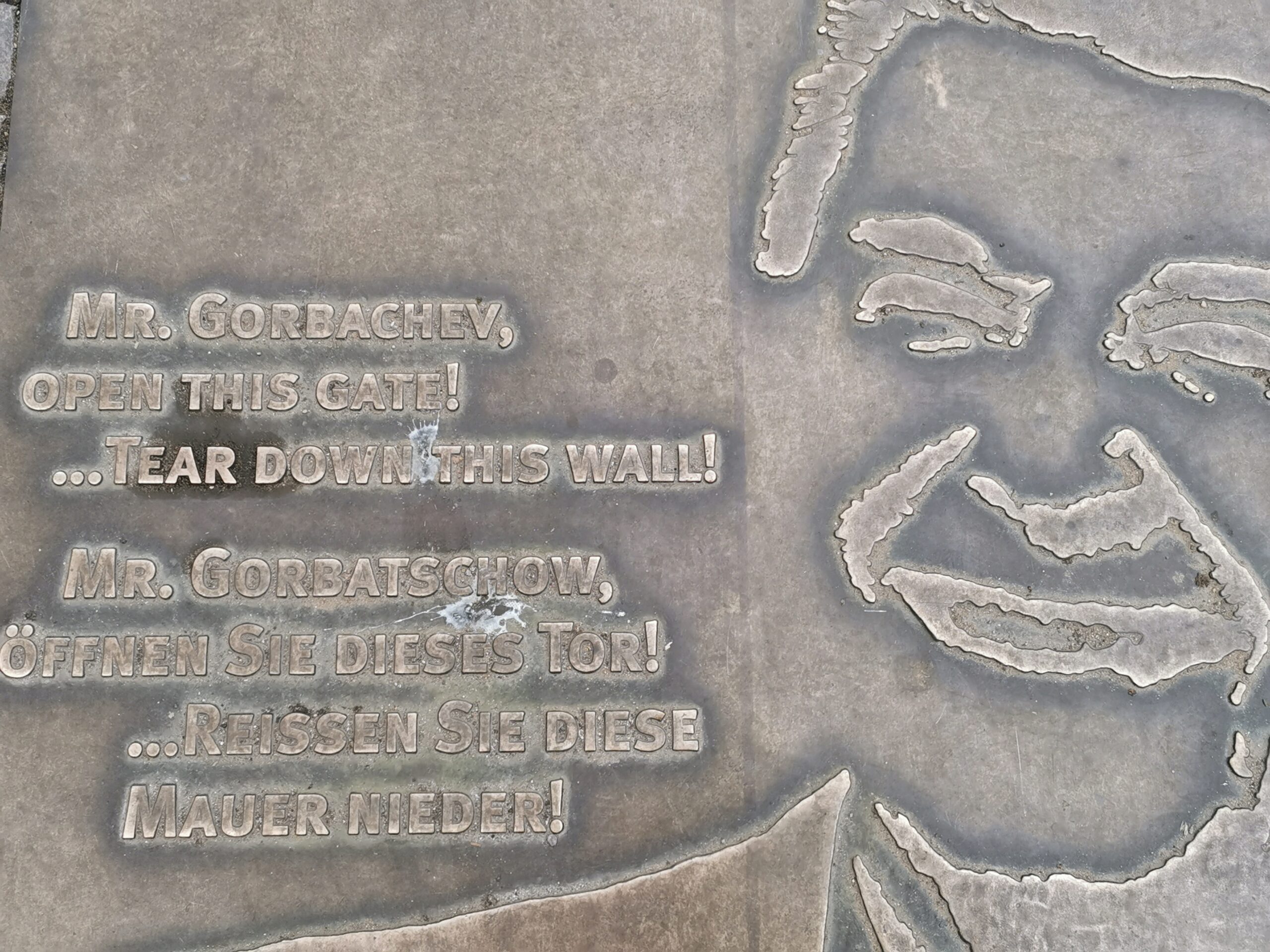
This photograph, taken in Berlin in 2020, captures an engraved inscription commemorating one of the most significant moments of the late Cold War: the call to “tear down this wall.” The image offers a visual analysis of how political language becomes embedded in space, transforming historical events into lasting material memory.
The composition centers on the engraved text, which reproduces the well-known appeal associated with the division of Berlin and its eventual overcoming. The use of both English and German reinforces the dual audience of the message, reflecting its global significance as well as its local context.
Unlike monumental architecture, this form of commemoration operates at a more intimate scale. The text is not elevated or distant, but integrated into the surface, inviting close engagement. This proximity alters the viewer’s experience, shifting from observation to reading, and from spectacle to reflection.
The inclusion of a human face, rendered in relief beside the inscription, introduces a personal dimension to what is often understood as a geopolitical event. It connects abstract political processes to individual agency, emphasizing the role of actors within historical change.
From a visual history perspective, the image highlights the power of language in shaping collective memory. Words, when inscribed into public space, acquire permanence and authority, becoming part of the physical environment through which history is encountered.
At the same time, the photograph reflects the transformation of Berlin itself—from a divided city to a site of memory and reconciliation. The inscription does not simply recall the past; it actively participates in how that past is remembered and interpreted.
Ultimately, this Berlin photograph (2020) can be read as a study of how history is written into space. It reveals how political discourse, once spoken, can become material, enduring as part of the urban landscape and shaping future understandings of the past.


Commenti recenti