Ethnicity, Urban Memory, and Cultural Hybridity (San Francisco, 2008)
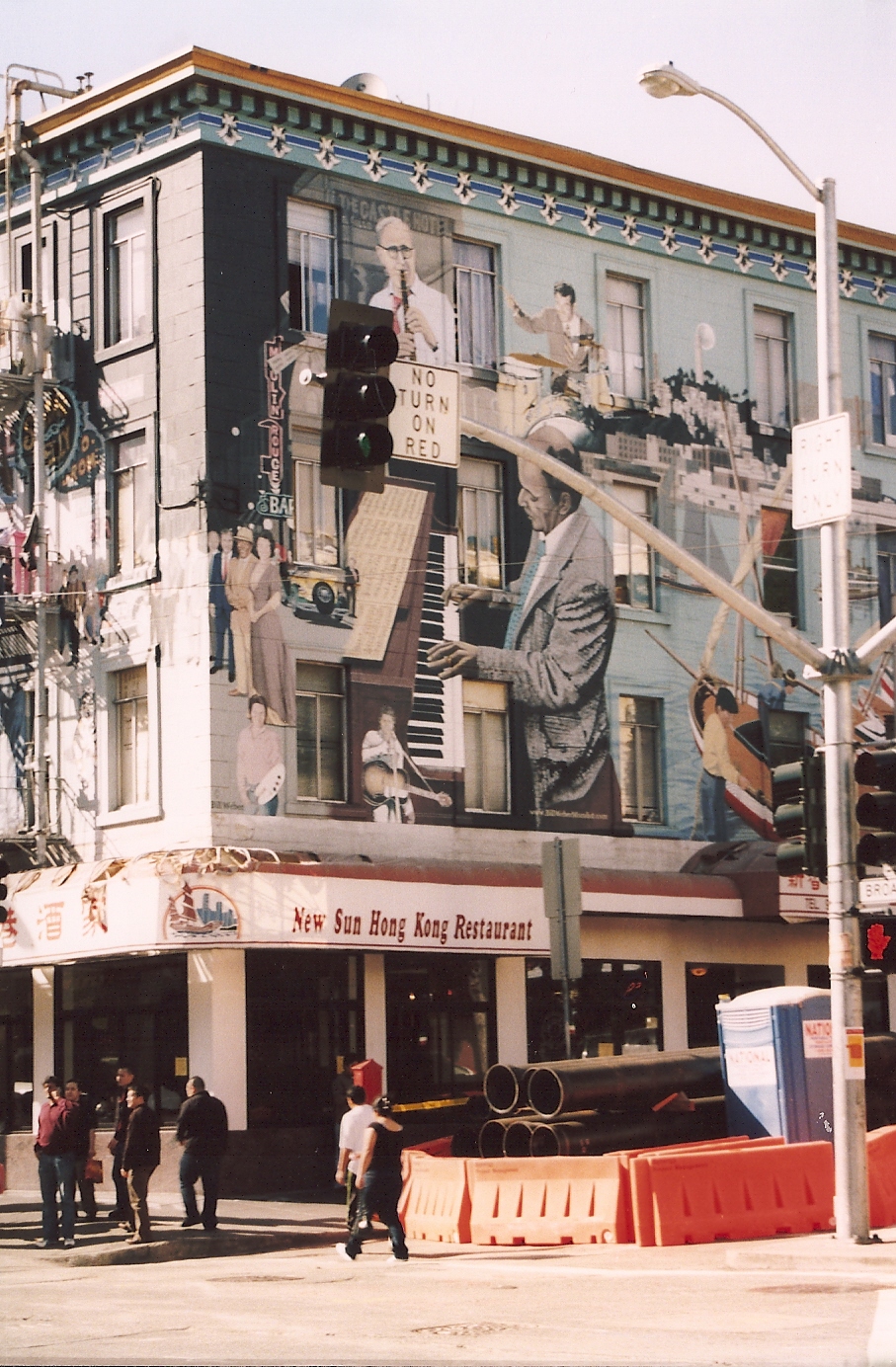
This photograph, taken in San Francisco in 2008, captures the layered cultural geography of a global city shaped by migration, commerce, and everyday multicultural interaction. The image centers on a large mural covering the façade of a corner building in Chinatown, where musicians, performers, and scenes of urban life are integrated into a visual narrative of collective memory. Beneath the mural, commercial activity, pedestrians, traffic signals, and restaurant signage situate cultural representation within the rhythms of ordinary urban experience.
The mural functions as more than decoration. It operates as a form of public storytelling through which the neighborhood visually preserves its historical identity within a rapidly transforming metropolis. Music occupies a central symbolic role in this representation. Jazz musicians, performers, and entertainment imagery evoke the long history of cultural exchange that characterized twentieth-century American urban life. The photograph therefore reflects how immigrant neighborhoods frequently become spaces of cultural hybridization rather than isolated ethnic enclaves.
Particularly significant is the coexistence of Chinese commercial identity and broader American popular culture. The “New Sun Hong Kong Restaurant” signage anchors the image within the Chinese-American experience, while the mural simultaneously references forms of entertainment associated with wider urban modernity. This overlap illustrates how diasporic communities negotiate integration not through cultural disappearance, but through adaptation and reinterpretation. Identity emerges as layered, relational, and continuously reconstructed.
The photograph also reveals the material texture of everyday globalization. Construction barriers, street infrastructure, traffic systems, and commercial storefronts coexist with symbolic representations of memory and culture. Urban life appears fragmented yet interconnected: heritage, labor, mobility, tourism, and commerce all occupy the same physical space. Such environments are characteristic of late twentieth- and early twenty-first-century global cities, where migration reshaped both the demographic and symbolic organization of urban space.
From the perspective of global history, Chinatown can be interpreted as part of broader transnational networks linking Asia and North America through migration, trade, labor, and cultural circulation. Neighborhoods like this emerged historically from exclusion, segregation, and economic marginalization, yet over time they also became central sites of cultural production and urban identity. The mural expresses precisely this dual condition: the desire to preserve communal memory while simultaneously participating in the larger narrative of the American metropolis.
The visual prominence of music and performance is equally important. Popular culture here acts as a shared language capable of crossing ethnic and social boundaries. Urban murals often transform walls into collective archives where communities narrate themselves publicly, claiming symbolic visibility within contested metropolitan environments. The city becomes a canvas upon which migration histories and local identities are continuously rewritten.
Ultimately, the photograph documents how everyday urban life is shaped by overlapping systems of consumption, memory, and cultural representation. It reveals the global city not as a homogeneous space, but as a mosaic of interconnected histories embedded within ordinary streets, commercial façades, and public imagery.



Commenti recenti