Roger Waters, The Wall, and the West’s Short Memory
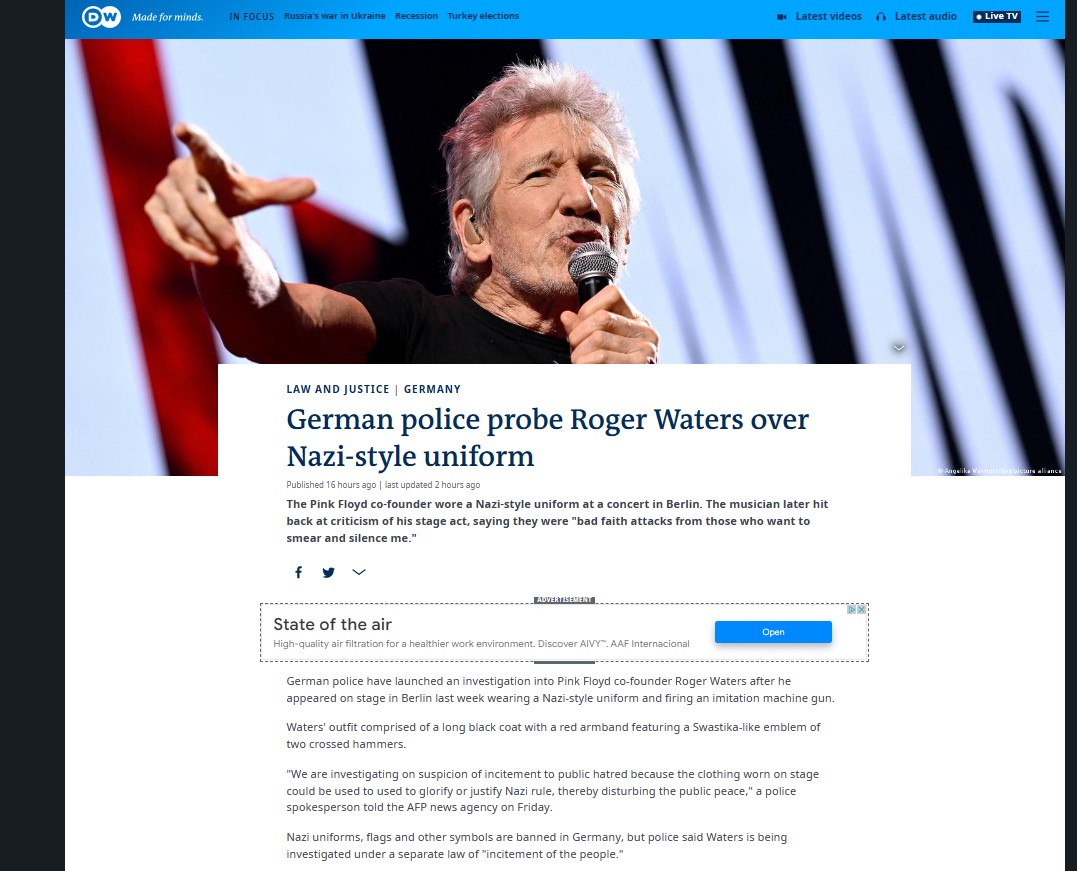
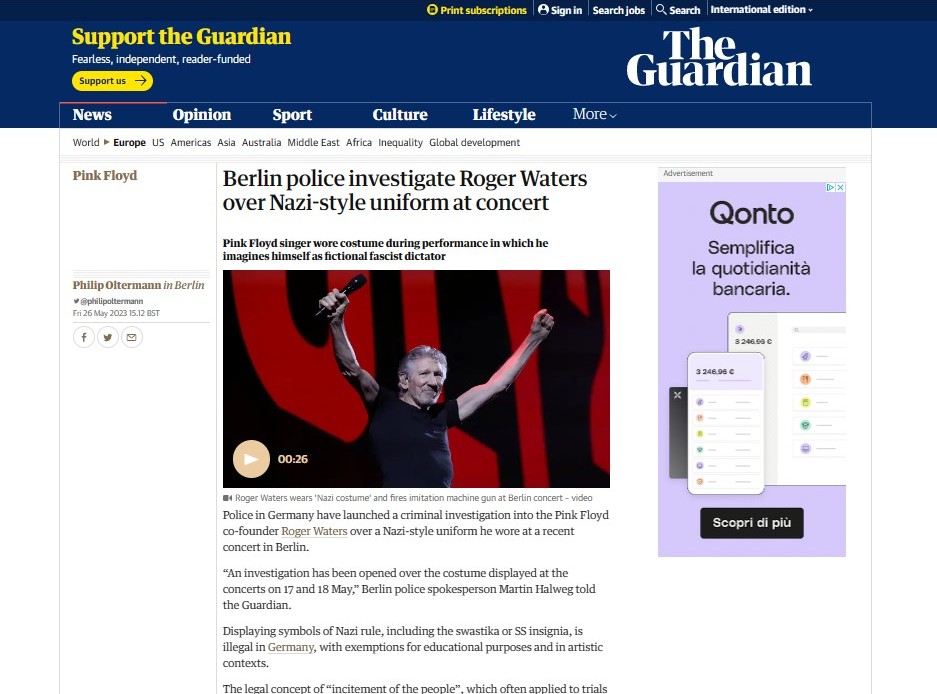
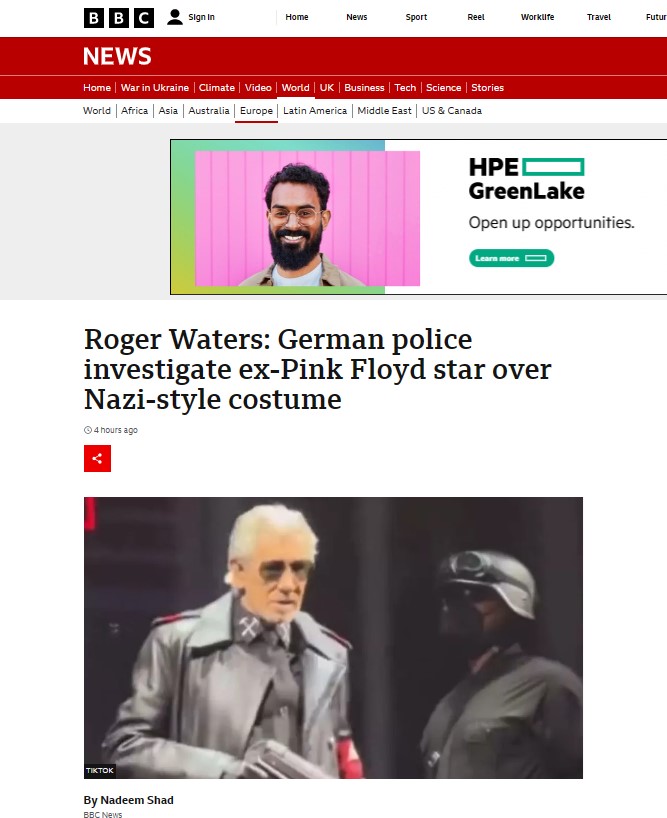
In 2023, several major European media outlets widely circulated the news that German police had opened an investigation into Roger Waters following the use, during a concert, of costumes inspired by the totalitarian imagery portrayed in The Wall.
Headlines, photographs, and carefully selected frames extracted from their theatrical context rapidly shaped a simplified narrative: Waters portrayed as a controversial figure ambiguously flirting with authoritarian symbolism, if not openly indulging it.
Yet the central issue lies elsewhere. Anyone genuinely familiar with The Wall understands that such imagery was never conceived as a celebration of totalitarianism, but rather as its explicit condemnation.
The Wall as Political Critique, Not Political Endorsement
Since its release in 1979, The Wall has stood as one of the most significant anti-authoritarian and anti-militarist works in contemporary popular music. The dictatorial persona performed by Waters during the famous fascist sequence represents a grotesque theatrical embodiment of power taken to its pathological extreme.
Its purpose is not glorification, but exposure. Not admiration, but critique.
The sequence functions as political theatre — a deliberate dramatization of the psychological mechanisms underlying mass conformity, fanaticism, and authoritarian violence.
To isolate visual fragments from this narrative framework and present them as evidence of ideological sympathy is intellectually disingenuous. By the same logic, any actor portraying a dictator in cinema or theatre could be accused of endorsing the ideology being represented.
Such a reading becomes even more untenable when considered against the broader trajectory of Waters’ artistic and political work over the past five decades.
Roger Waters and a Lifetime of Anti-Militarism
Waters’ artistic worldview is inseparable from personal history. His father, Eric Fletcher Waters, died during the Second World War when Roger was still an infant. That loss profoundly shaped his lifelong opposition to war, nationalism, militarism, and political propaganda.
Throughout his career — from songs such as “Us and Them” and “Bring the Boys Back Home” to later works like The Final Cut and Amused to Death — Waters consistently articulated a critique of military culture and the political exploitation of fear.
His positions have often been controversial, particularly because he has criticized both Western and non-Western governments, military interventions, and geopolitical power structures with equal intensity. One may legitimately disagree with his political interpretations; however, portraying him as sympathetic to fascist ideology requires the complete erasure of decades of openly anti-authoritarian artistic expression.
The Historical Irony of Berlin, 1990
The controversy becomes even more paradoxical when viewed through a historical lens.
In 1990, following the fall of the Berlin Wall, it was precisely Roger Waters who was chosen to commemorate one of the defining symbolic moments of post-Cold War Europe: German reunification.
On July 21, 1990, Waters staged a monumental live performance of The Wall at Potsdamer Platz in Berlin, before an audience of hundreds of thousands and alongside numerous international guest artists. At the time, the event was celebrated as a cultural symbol of liberation, reconciliation, and the end of Europe’s ideological divisions.
No serious public discourse then suggested that the theatrical representation of authoritarian aesthetics constituted an endorsement of authoritarian ideology. On the contrary, those same artistic elements were widely understood as integral to the work’s anti-totalitarian message.
The contrast with the media framing seen in 2023 is therefore striking. The imagery remained unchanged; what changed was the political and interpretative environment surrounding it.
Geopolitical Crisis and Instrumentalized Information
The broader significance of the Waters case lies precisely here.
The current geopolitical climate — shaped by the war in Ukraine, increasing political polarization, and an increasingly binary media ecosystem — has contributed to a public discourse in which nuanced positions are progressively marginalized. Individuals who challenge dominant narratives, particularly regarding NATO, militarization, or Western foreign policy, are frequently subjected to forms of media simplification that reduce complex political identities to morally polarized caricatures.
Within such a framework, context becomes secondary to perception management.
The long-established historical meaning of The Wall as a critique of authoritarianism matters less than the emotional and symbolic impact generated by decontextualized images circulating through digital media ecosystems.
The result is a broader transformation in the function of information itself. Rather than facilitating understanding, media narratives increasingly operate through symbolic reduction, emotional framing, and selective contextualization aimed at shaping public reactions.
The Fragility of Cultural Memory
The Roger Waters controversy ultimately reveals how fragile cultural memory can become when historical context is systematically removed.
The same artist who, in 1990, was publicly celebrated in Berlin as a symbolic voice against ideological division was, in 2023, reframed by portions of the media through a radically different interpretative lens using precisely the same artistic material.
Yet The Wall itself has not changed.
Nor has the central political message that has defined Waters’ work for decades.
What has changed is the political climate through which that work is interpreted, filtered, and publicly narrated.
And perhaps this, more than the controversy itself, is the most revealing aspect of the entire episode.
Federico Paolini
This article is part of the research project: Music, Power and Global Inequality.

Commenti recenti