Performance, Imitation, and Urban Spectacle in Portland (2010)
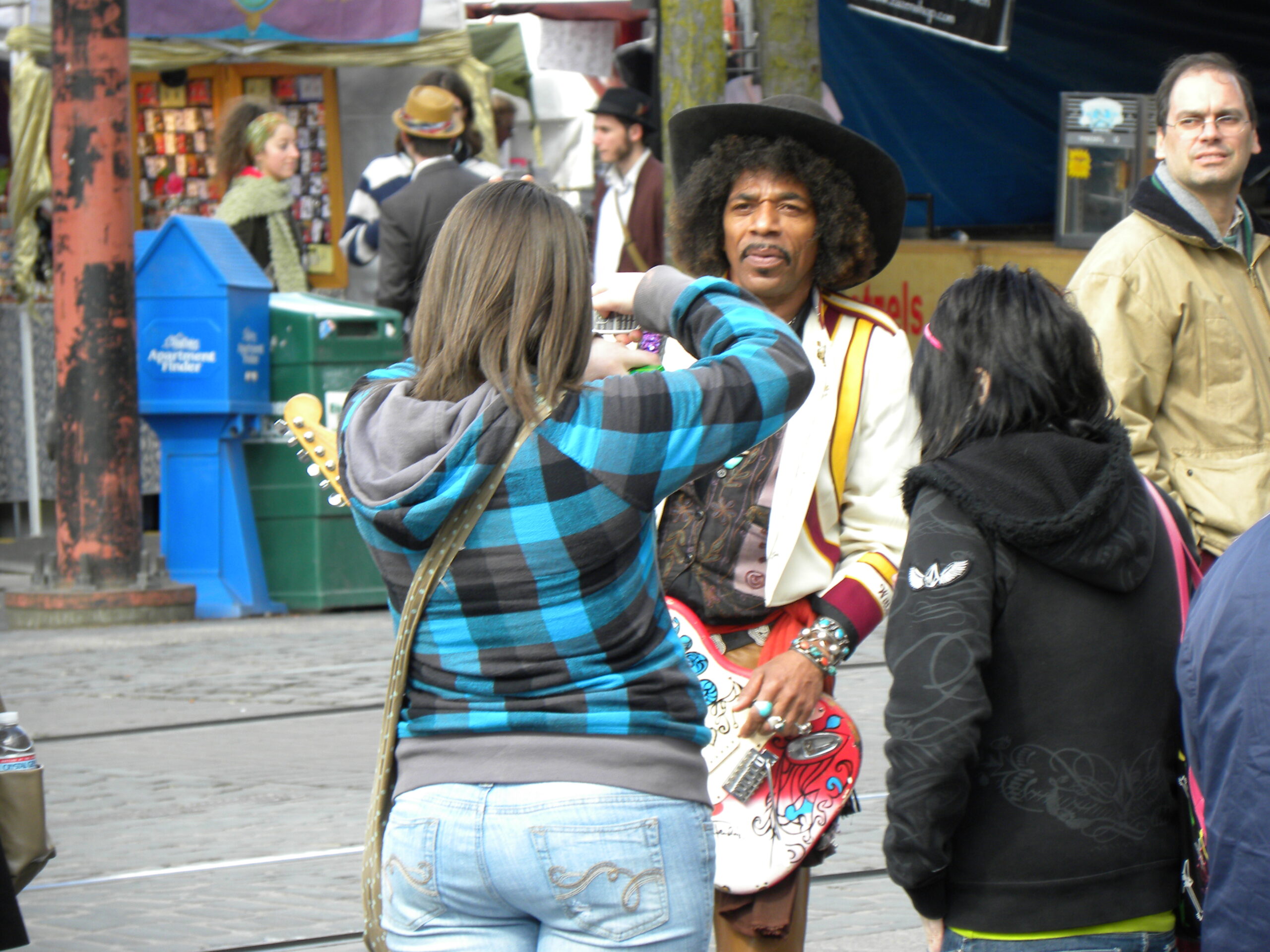
This photograph, taken in Portland in 2010, captures a moment of street performance within a busy urban market, where a musician—visually styled after Jimi Hendrix—interacts with passersby. The image offers a reflection on imitation, performance, and the circulation of cultural icons within everyday urban space.
At the center of the composition, the performer adopts recognizable visual codes associated with Hendrix: the hat, the guitar, and the expressive posture. These elements do not aim at exact replication but rather at evoking a widely shared cultural image. The figure becomes a mediator between past and present, transforming a historical music icon into a living, performative presence embedded in the street.
The surrounding environment plays a crucial role in shaping this interaction. The informal setting of the market, with its stalls, signage, and casual movement of people, situates the performance within the rhythms of everyday life. Unlike staged concerts or institutionalized performances, this moment unfolds within an open and fluid space, where the boundaries between performer and audience remain porous.
A key aspect of the image is the act of documentation itself. The central figure in the foreground, captured while photographing the performer, introduces a second layer of mediation. The performance is not only lived but immediately transformed into an image, suggesting how contemporary urban experience is continuously filtered through acts of recording and sharing. This dynamic highlights the integration of visual culture and digital practices into ordinary interactions.
From a broader perspective, the photograph reveals how global cultural icons are reinterpreted and reproduced at the local level. The presence of a Hendrix-like figure in a Portland street market exemplifies the circulation of popular culture across geographical and social contexts. At the same time, the performance is shaped by its specific environment, creating a hybrid form that is both globally recognizable and locally situated.
The image also points to the economy of attention that characterizes contemporary urban life. The performer’s role is to attract, engage, and momentarily suspend the flow of the crowd, transforming a transient public space into a site of spectacle. In this sense, the street becomes a stage where identity, memory, and entertainment intersect.
Ultimately, this photograph can be read as an exploration of how cultural memory is enacted through performance in everyday contexts. The figure of Hendrix is not simply remembered but actively re-performed, allowing the past to re-emerge within the present urban landscape. The result is a dynamic interplay between authenticity and imitation, presence and representation, that defines much of contemporary visual culture.


Commenti recenti