Zócalo, Mexico City (2001): Popular Memory, Political Iconography, and Urban Power
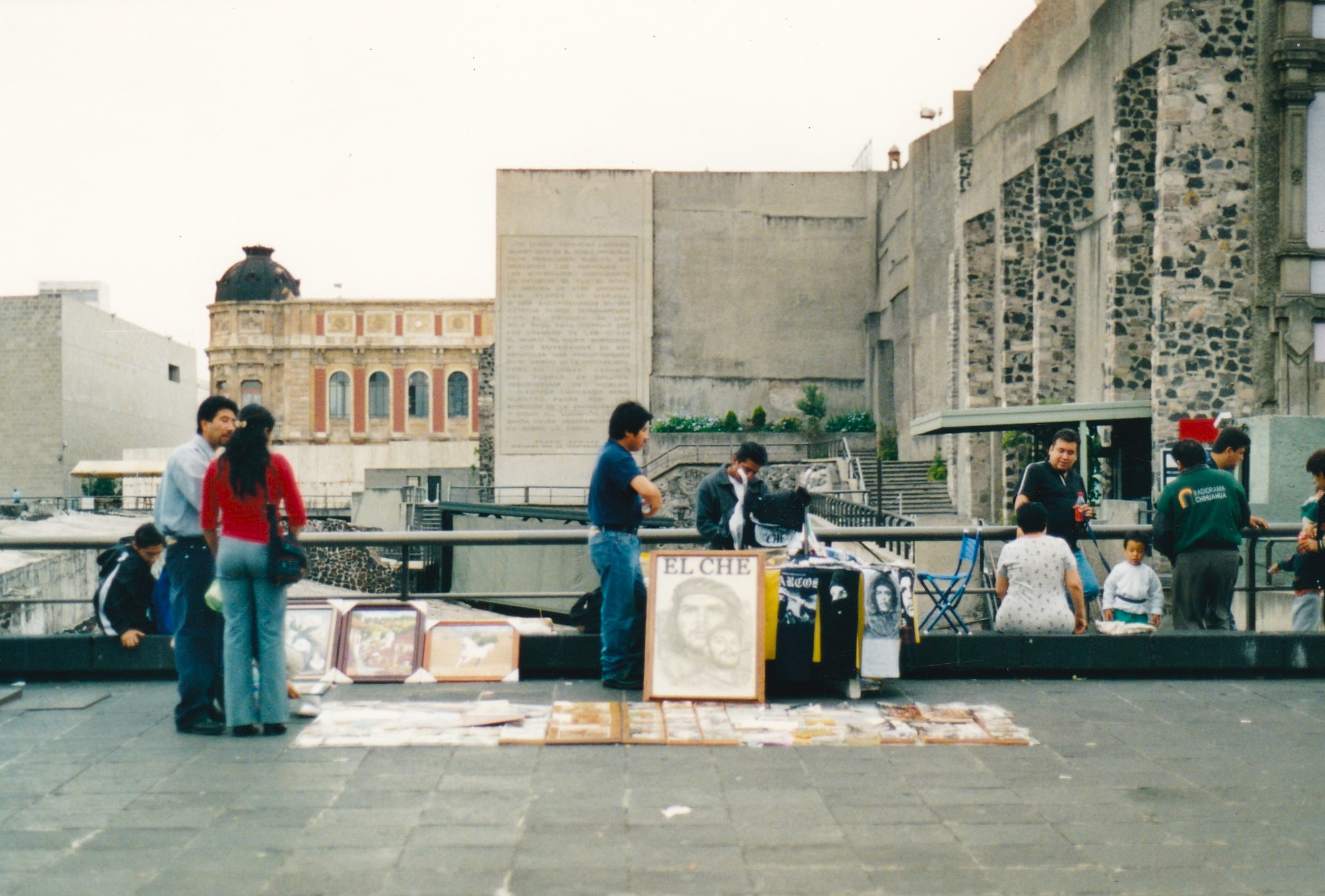
This photograph, taken in 2001 in the Zócalo—the main square of Mexico City—captures a moment in which popular memory, political iconography, and urban space intersect. The Zócalo, one of the largest and most historically significant public squares in the world, has long functioned as a central stage for political power, civic rituals, and social interaction.
At the center of the scene, a street vendor displays a collection of images featuring Ernesto “Che” Guevara, whose portrait has become one of the most globally recognizable symbols of political resistance. In this context, the image of Che is not monumentalized in an official form but reproduced and circulated as a commodity within everyday urban life.
The choice of location is crucial. The Zócalo is not merely a public square but a symbolic and political space, historically associated with state authority, national identity, and public demonstrations. The presence of informal commerce within this setting highlights the coexistence—and tension—between institutional power and popular practices of memory.
Visually, the arrangement of the images on the ground contrasts with the monumental architecture surrounding the square, reinforcing the distinction between official narratives of history and alternative, grassroots forms of remembrance. The people gathered around the vendor further emphasize how memory is produced through interaction, exchange, and visibility.
From a broader perspective, the circulation of Che Guevara’s image in the Zócalo illustrates the global diffusion of political iconography. A figure rooted in Latin American revolutionary history becomes a transnational symbol, reinterpreted and consumed within different cultural and spatial contexts.
Within the framework of visual history, this photograph demonstrates how power, memory, and space intersect in complex and layered ways. The Zócalo functions as a site where institutional authority, commercial practices, and collective memory overlap, revealing the dynamic and contested nature of public space.
Ultimately, this image of the Zócalo in Mexico City (2001) shows how memory is not only preserved but continuously renegotiated within everyday urban environments, where global symbols and local practices converge.


Commenti recenti